
Author: Sophia Mehlhausen-Franks
Every year, mobile growth teams pour massive budgets into perfecting the top of the funnel. Marketers spend months fine-tuning App Store Optimization (ASO) strategies, obsessing over screenshot layouts, and optimizing Paid User Acquisition (UA) campaigns to lower Cost Per Acquisition (CPA). The mandate is clear: capture attention, build intent, and secure the install.
Yet, for many mobile apps, this is exactly where the strategic growth engine stalls. The moment a user clicks “Install,” a structural handoff occurs. The user is passed from the marketing team to the product team. Because these departments so often operate in organizational silos, this internal handoff creates a jarring user experience.
True conversion rate optimization does not end with the install. When a user drops off seconds after download, your acquisition budget didn’t just underperform; the investment in that user was essentially lost. To fix this classic leaky bucket problem, growth leaders must bridge the gap between acquisition and product retention by directly mapping app store intent to the first-time user experience (FTUE). Redefining success means changing how growth teams measure performance. ASO teams have long evaluated success based primarily on early-stage metrics like click-through rates and install volumes. Once the download happens, marketing checks the box and moves on. High install volume is a vanity metric if your Day 1 retention is abysmal. Growth leads must look further down the funnel and optimize for how quickly a user experiences the app’s actual benefits.
Onboarding Begins in the Store, Not the App
The biggest misconception in mobile product management is that onboarding starts at the first app launch. It doesn’t. Onboarding begins the moment a user encounters your ad or search listing. That is where expectations are set, and where psychological intent is built. It establishes a psychological contract regarding the value the app will deliver.
When your app treats every incoming user identically, it ignores the context of how they arrived. A user who searched the app store for “budget flight tracker” has a completely different mindset than one who clicked a social media ad highlighting “luxury weekend getaways.” Forcing both through the same onboarding sequence kills contextual relevance and spikes early churn.
Smart onboarding relies on absolute contextual continuity. Keeping the narrative thread intact from store to app drastically reduces drop-offs. If your store listing promises a specific utility, feature, or aesthetic, that exact value proposition must be reinforced within the first three seconds of the user opening the app. This reassures users that they are in the right place and carries their acquisition momentum cleanly into product adoption.
Building a Unified Funnel: CPPs and Deep Linking
Tailoring the onboarding process for large numbers of users used to present major technical hurdles. Today, the maturation of Apple’s Custom Product Pages (CPPs) and Google’s Custom Store Listings (CSLs), paired with robust deferred deep linking, has completely rewired mobile growth infrastructure.
Instead of routing all paid and organic traffic to a single, generic store page, marketers can now deploy up to 35 distinct custom product pages tailored to specific audience segments, ad creatives, or keyword groups. This keeps the experience consistent from the first click to the download:
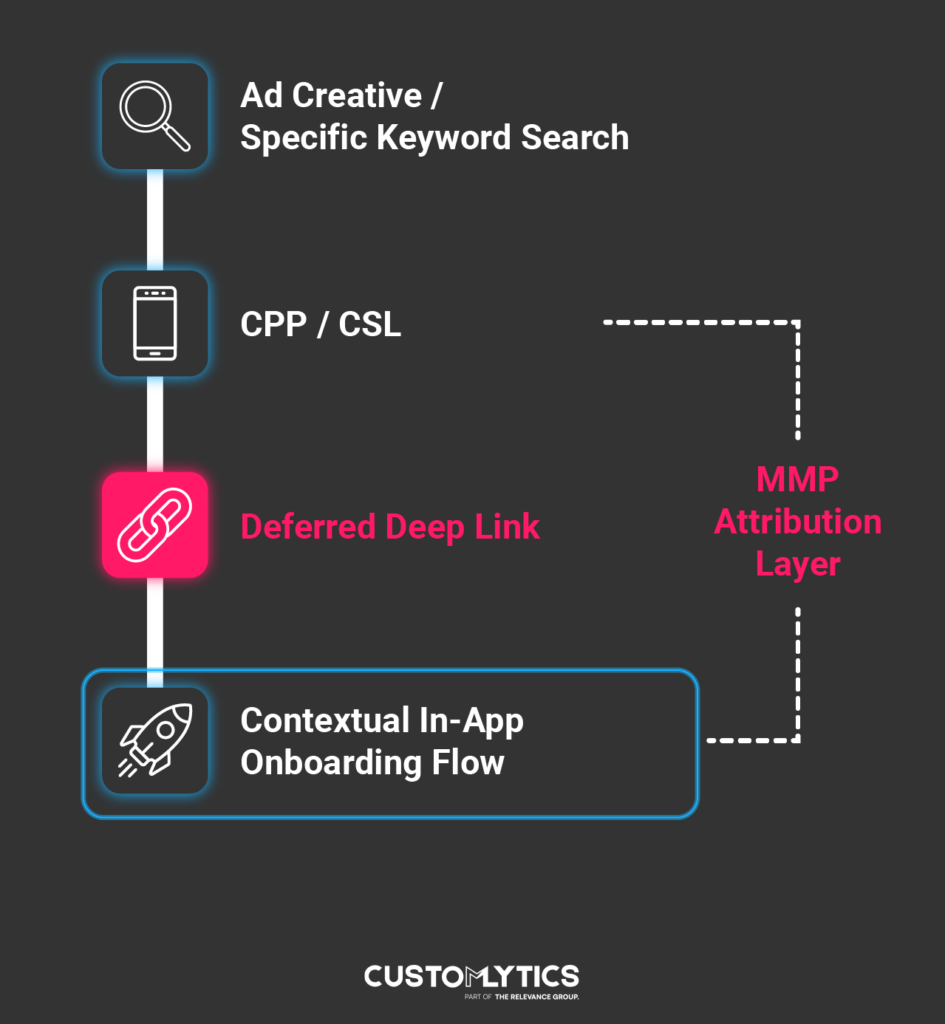
To make this infrastructure work, your marketing stack must speak directly to your product environment via a Mobile Measurement Partner (MMP). When a user downloads the app via a specific CPP, a deferred deep link passes that context to the app, instantly triggering a tailored onboarding flow that mirrors the imagery and copy of the page they just left.
For example, a fitness app running a campaign targeting users looking for “postpartum yoga” can direct traffic to a yoga-specific CPP. Upon opening the app, the deferred deep link ensures the user completely bypasses generic weightlifting or running questionnaires, routing them directly to a yoga-centric welcome path. This technical alignment prevents user disorientation and reinforces the exact promise that triggered the install.
This seamless handoff from asset to app isn’t just a best practice; it drives measurable bottom-line growth. Our recent project with Telekom Magenta Zuhause shows how this works in practice.
Success Story: Reaching New Audiences with Telekom Magenta Zuhause
At Customlytics, we regularly challenge clients to abandon the traditional metric silo. When you optimize for value realization by aligning top-of-funnel CPP infrastructure with targeted campaigns, the impact on conversion is stark.
Our client, Magenta Zuhause, has an app that offers multiple features for many different use cases within your smart home. The Custom Product Pages offer the ideal solution to showcase those different use cases to new users and target them with the content relevant to them.
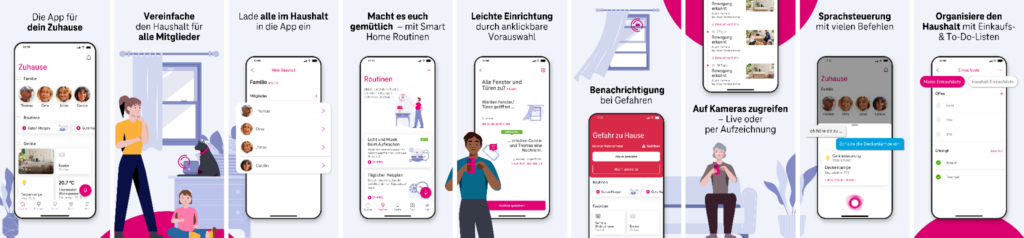
(Previous Store Page visible to all users)
We prepared CPPs for the most popular use cases, including gardening, network management, and energy saving. For the energy-saving Custom Product Page, the intent was to showcase how the app can be used specifically to save energy, and it was shown directly to users searching for energy-saving related keywords.
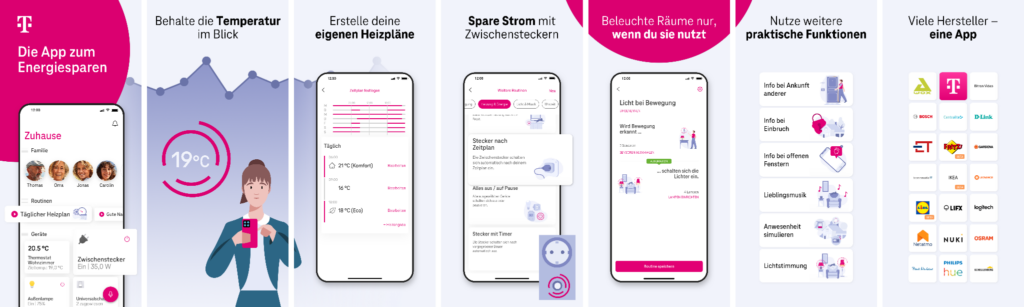
(Custom Product Page for the topic of energy saving)
By running Apple Search Ads (ASA) campaigns promoting the app via these tailored CPPs, we were able to present the right page with the right keywords to users. Reaching these new audiences via the ASA campaign yielded immense results. After just one month, the Custom Product Page achieved a significantly higher conversion rate than the default campaign, increasing by 16%.
A Tactical Growth Blueprint
To turn this strategic viewpoint into execution, run your current user journey through this quick acquisition audit checklist:
- Map Ad Creatives to Store Pages: Ensure your highest-spending UA campaigns route to dedicated Custom Product Pages or Store Listings that perfectly match the visual asset and messaging style of the ad.
- Audit from the Store Perspective: Download your own app from the perspective of different acquisition keywords. Does the first screen immediately validate why you downloaded it based on that keyword, or does it dump you into a generic dashboard?
- Establish Cross-Channel Continuity: Treat the ecosystem as one fluid space. If a user starts onboarding on the mobile app, drops off, and returns later via a web or email re-engagement campaign, lifecycle automation (via platforms like MoEngage) should allow them to pick up exactly where they left off.
Stop Leaking Ad Spend: Building a High-Performance Growth Funnel with Customlytics
The era of scaling mobile apps through isolated, tactical marketing hacks is over. Achieving sustainable, long-term growth and scaling customer lifetime value requires tight synchronization between marketing infrastructure and product design. By aligning your ASO strategy directly with a contextualized, low-friction entry point, you respect the user’s intent and time. The install shouldn’t mark the completion of marketing’s job, but rather the introduction to a seamless product experience.
At Customlytics, we focus on the infrastructure that makes this exact continuity possible. We help app companies align their top-of-funnel acquisition with high-performance product experiences. Our work spans ASO optimization, Custom Product Page configuration, deferred deep linking architecture, and the integration of marketing measurement tools. We break down corporate silos to bridge the gap between marketing, data, and product teams, ensuring your technology stack converts high-intent traffic rather than letting it drop off.
If you want to move beyond vanity install metrics and build a highly synchronized growth funnel, drop us a line. We are happy to provide the technical expertise and strategic guidance to help you scale.
Now that your marketing infrastructure is set up, read our companion guide on how to design the perfect in-app onboarding experience to match.
Helpful Links: