
Author: Sophia Mehlhausen-Franks
Discover how top-tier mobile product teams reduce friction, leverage behavioral psychology, and use delayed registration to optimize Time-to-Value (TTV) during the first 60 seconds of the app onboarding experience.
The moment a user opens your app for the first time, a crucial psychological window opens. High-intent users, won over by a highly specific product promise during their acquisition journey, are very motivated, but that motivation is incredibly fragile. Far too often, opening an app results in a jarring experience: users are greeted by a generic, one-size-fits-all welcome screen demanding immediate account creation and a barrage of system permissions.
The first 60 seconds of the in-app experience are critical to securing long-term conversion rates. To reduce early churn, focus on speeding up Time-to-Value (TTV) so users see results faster. This measures how fast a user experiences the “aha moment” where the app’s utility becomes undeniable.
Designing the Frame: Dynamic Approaches to the In-App Experience
There is no single blueprint for onboarding. The old-school, multi-screen “function tour” that shows users a slideshow of buttons no longer aligns with user expectations. Users rarely have the patience to read long instructions; if an app requires complicated instructions to navigate, the user interface is not intuitive enough.
Instead, strong product teams combine different tactical approaches based on their specific data needs and complexity. The key isn’t to overwhelm users with information before they’ve even touched the dashboard, but rather to use the right psychological triggers at the right time.
Here are the most effective ways to design that initial interaction:
The Value-First Slide Sequence (Focus on Benefits & Trust)
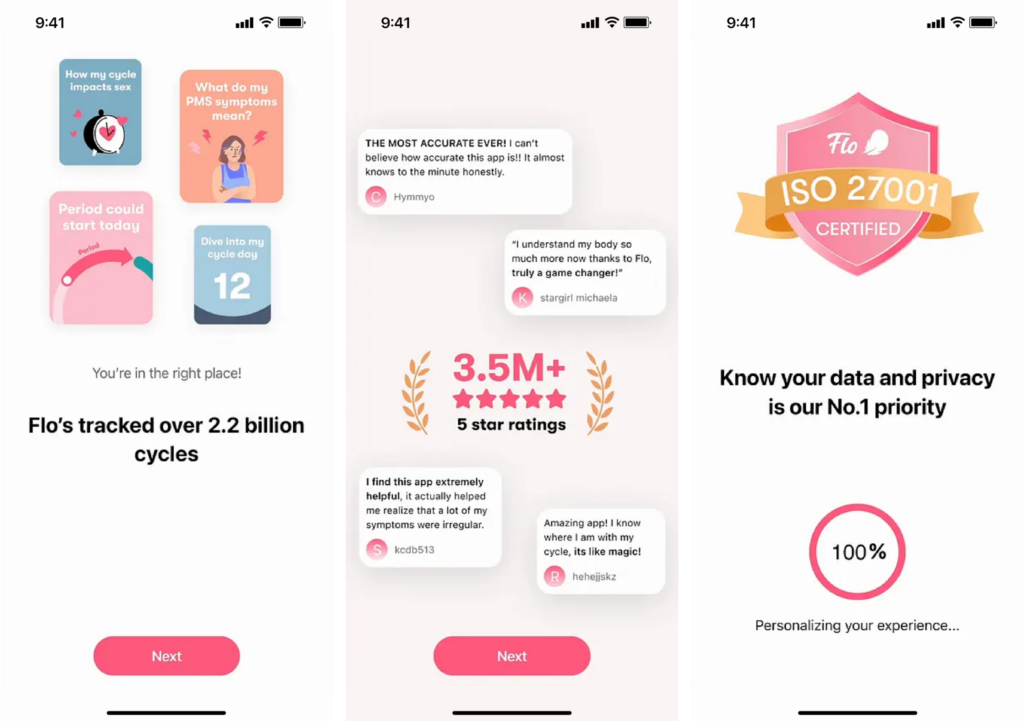
Instead of forcing a user to look at features, this approach focuses entirely on why the user needs the app, reinforcing the exact unique selling points they saw on your Custom Product Pages. It’s the easiest flow to align directly with your ASO strategy. Today, leading apps use this moment to lean heavily into social proof and authority biases.
- Real-World Case Study: Look at Flo Health. Their onboarding heavily leverages trust-builders right out of the gate. Before asking for deeply personal data, the app flashes screens highlighting their massive user base, showing off millions of downloads, and prominently featuring their 5-star ratings and ISO certification. By showing that millions of others trust the platform, they lower the user’s psychological barrier to entry.
Interactive “Learn-by-Doing” Onboarding (Immediate Experiential Value)
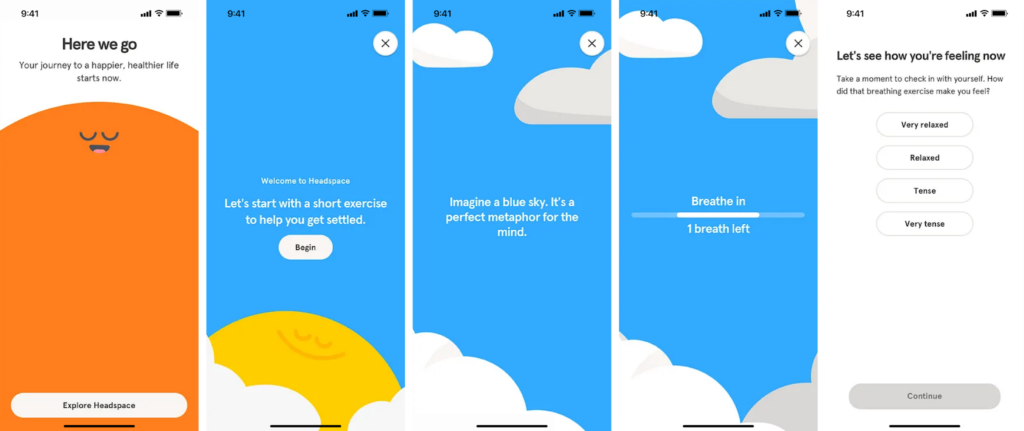
Rather than front-loading information via static slides, this approach drops users straight into a micro-experience. It bypasses passive reading and turns them into active participants immediately, driving them rapidly toward their “aha moment.”
- Real-World Case Study: Headspace executes this beautifully. Instead of explaining what mindfulness feels like, they invite you to experience it right inside the onboarding sequence. They offer a bite-sized, 1-minute guided breathing exercise or mini-meditation lesson before you ever hit a main dashboard. You experience the core value of the product before you’ve even had time to think about exiting.
The Curated Profile Builder (Account Setup)
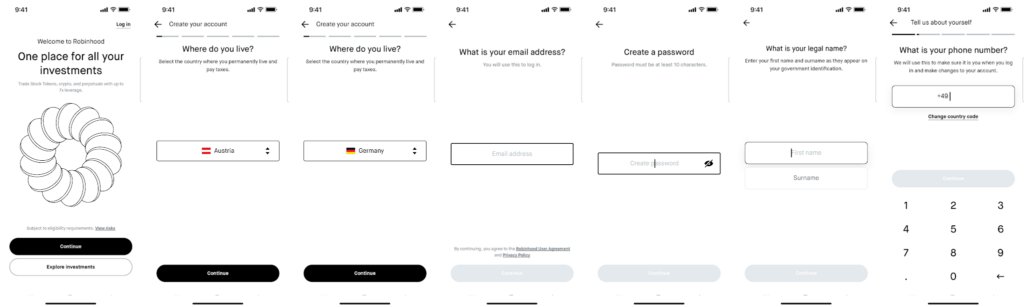
Some apps simply cannot function without user data. If you are a fintech app, a hyper-personalized health tool, or a social network, you need a profile.
- Real-World Case Study: Neo-banking and investment apps like Revolut or Robinhood offer great examples of how to navigate this challenge. Because they are bound by strict financial regulations in Europe, they face a unique product challenge: they cannot utilize delayed registration. They are legally mandated to verify a user’s identity and complete baseline compliance checks before granting access to financial services. To combat the risk of immediate user drop-off, these platforms break down mandatory data collection into highly optimized, single-input screens, using clean typography, encouraging micro-copy, and prominent macro-progress bars to keep the user moving forward seamlessly.
The Strategic Power of Delayed Registration
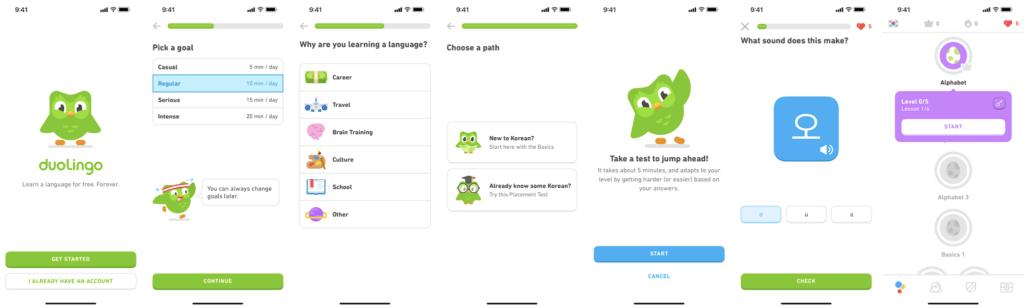
One of the sharpest ways to capitalize on high app store intent is to implement delayed registration. Forcing account creation, email verification, and password setup before a user even sees the inside of the app introduces immediate friction.
When a user installs an app, their intent and excitement are at a peak. By letting users explore the app, configure preferences, or sample content while that excitement is fresh, you help users feel familiar and comfortable with the app before they are asked to commit to an account. Once they recognize the tangible value of the product, asking for registration becomes a natural next step to save their progress rather than an obstructive gatekeeper.
- Real-World Case Study: Duolingo handles this exceptionally well. When you open the app, it doesn’t ask who you are. It immediately launches you into a fun, 2-minute language lesson. You match words, earn points, and visually map out your upcoming learning path. By the time you are asked to enter an email address, you are already hooked on a win streak. You are invested.
Redefining Success and Shifting the Core Metric
Aligning marketing and product requires fundamentally changing how growth teams measure success. ASO teams usually prioritize top-of-funnel metrics like click-through rates and install volumes. Once the download happens, marketing checks the box and moves on.
At Customlytics, we regularly challenge clients to abandon this metric silo. High install volume doesn’t mean much if Day 1 retention is low. Growth leads must look further down the funnel and optimize for the velocity of value realization, also known as Time-to-Value (TTV). This measures how fast a user experiences the “aha moment” where the app’s utility becomes undeniable.
Optimizing for value realization requires product teams to make the sign-up process as smooth as possible. In a past project optimizing the onboarding flow for Telekom’s Magenta SmartHome App, we designed and tested multiple onboarding variations, automatically guiding users through registration, device pairing, and setup. If a user got stuck at any point, the app automatically prompted them with the next step.
The baseline performance variations across these five flows reveal exactly how much impact a tailored experience has on final user activation:
- Flow 1 Conversion Rate: 46.7%
- Flow 2 Conversion Rate: 83.1%
- Flow 3 Conversion Rate: 54.1%
- Flow 4 Conversion Rate: 17.5%
- Flow 5 Conversion Rate: 27.9%
The massive variance from a low of 17.5% to a high of 83.1% demonstrates that without proper guidance and timely Calls-to-Action, this unfamiliar registration process can become highly time-consuming and complicated. When support is lacking, there is a great risk of users abandoning the onboarding process prematurely, rendering top-of-funnel investments inefficient and potentially losing those customers forever.
Tactical Blueprint for Growth Leaders
To turn this strategic viewpoint into execution, run your current user journey through this quick audit checklist:
- Map Ad Creatives to Store Pages: Ensure your highest-spending UA campaigns route to dedicated Custom Product Pages or Store Listings that perfectly match the visual asset and messaging style of the ad.
- Audit the First 60 Seconds: Download your own app from the perspective of different acquisition keywords. Does the first screen immediately validate why you downloaded it, or does it dump you into a generic dashboard?
- Test Friction Postponement: Experiment with moving system permissions (push notifications, tracking) and registration screens to a point after the user has completed a core action or achieved a micro-win.
- Cross-Channel Continuity: Treat the ecosystem as one fluid space. If a user starts onboarding on the mobile app, drops off, and returns later via a web or email re-engagement campaign, lifecycle automation (via platforms like MoEngage) should allow them to pick up exactly where they left off.
Stop Tracking Installs, Start Retaining Users
Scaling mobile apps today takes more than isolated marketing hacks. Achieving sustainable, long-term growth and scaling customer lifetime value requires tight synchronization between marketing infrastructure and product design.
By aligning your ASO strategy directly with a contextualized, low-friction onboarding experience, you respect the user’s intent and time. Stop treating the install as the finish line. Treat it as the handshake that introduces the user to a seamless, continuous experience built to retain them for the long haul.
How Customlytics Bridges the Post-Install Chasm
Achieving sustainable, long-term growth and scaling customer lifetime value requires tight synchronization between how a user is acquired and how they are handled inside the product environment. An unoptimized, rigid onboarding sequence can actively alienate up to 80% of acquired traffic. By designing a first-time user experience that respects user psychology, reduces immediate friction, and accelerates Time-to-Value, you transform a fragile download into a retained, long-term user.
At Customlytics, we help product and growth teams bridge the gap between data, infrastructure, and user experience. We break down corporate silos to ensure your product onboarding is highly contextualized, friction-managed, and technically aligned with incoming traffic patterns.
If you want to move beyond vanity install metrics and build a highly synchronized growth funnel, drop us a line. We are happy to provide the technical expertise and strategic guidance to help you scale.
But remember: Before you can design this seamless onboarding flow, you must ensure you are passing the right contextual data from the very beginning by mastering Custom Product Pages and Deep Linking.
Helpful Links: