Author: Anna Sophie Bretschneider
Until recently, AI search visibility was something you could influence, but not directly control or reliably measure like a paid channel.
That has changed.
ChatGPT Ads officially launched across 31 European markets in August 2026, including Germany. Since August 31, German advertisers have also been able to access the platform directly through OpenAI’s self-service Ads Manager.
For app growth teams, this opens up a new acquisition channel. But it also creates a very familiar measurement problem.
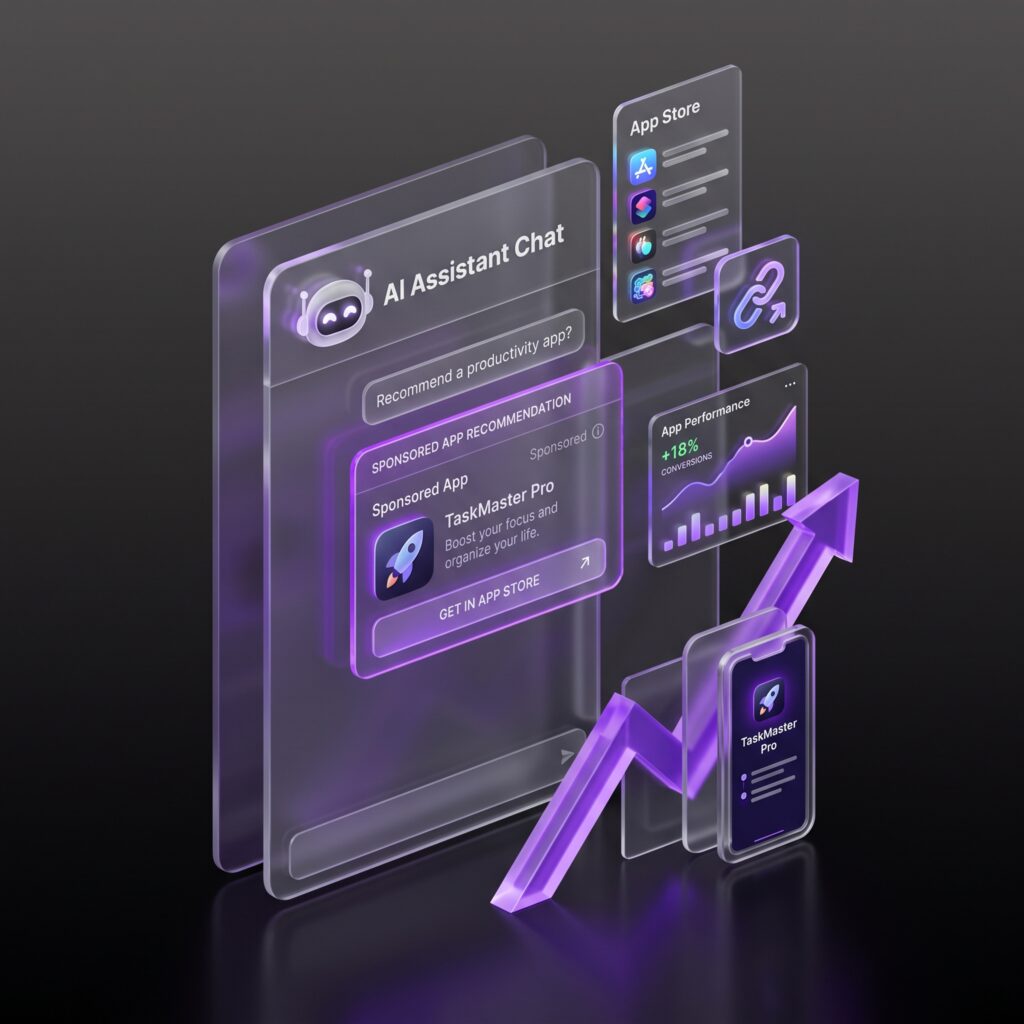
A user might discover your app while having a highly specific conversation, click an ad, land in the App Store, install the app and convert later. If your attribution, deep linking and event setup can’t connect those steps, the new channel quickly becomes another reporting black box.
The ad format is new. The measurement problems aren't.
Before putting meaningful budget behind ChatGPT Ads, app teams should make sure the entire journey from conversation to downstream app value actually works.
Here is what we would look at first:
1. Start With Use Cases, Not Just Keywords
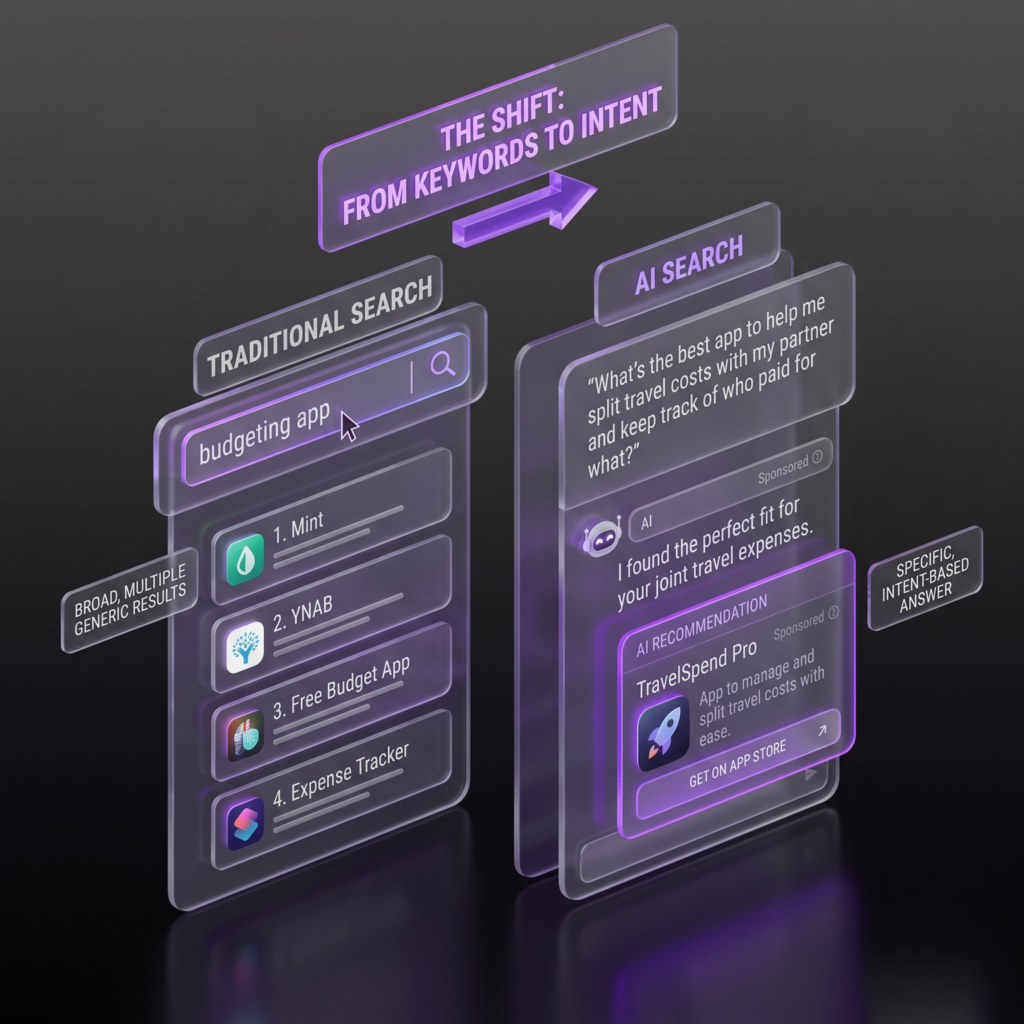
Traditional user acquisition often starts with short keyword phrases like “budgeting app”, “running app” or “expense tracker”.
ChatGPT Ads operate in a different environment.
OpenAI uses the context and intent of the current conversation alongside signals such as the ad, landing page and advertiser-provided context hints to determine relevance. Those context hints are not exact-match keywords. Instead, they describe situations, needs or topics in which a product may be useful.
So instead of only thinking: “expense tracker”, consider the actual context behind it:
“I need an easy way to split travel expenses with my partner.”
Or instead of: “running app”, think: “I’m training for my first 5K and need something simple that keeps me accountable.”
This doesn’t mean trying to predict the exact prompt someone will type. It means structuring campaigns around real customer needs and use cases instead of treating conversational advertising like another keyword list.
OpenAI recommends separating meaningfully different use cases into seperate ad groups when they require specific messaging or landing pages.
For app marketers, that should go one step further.
How to structure campaigns around real customer needs:
- Audit App Store reviews, customer support tickets, CRM insights and user research for recurring customer problems.
- Group these into clearly different use cases.
- Build ad messaging around the actual problem the user is trying to solve.
- Check whether those different use cases also deserve different landing or App Store experiences.
The goal isn’t simply to make the ad more conversational. It’s to preserve the user’s intent after the click.
2. Map the Entire Journey Before You Launch
Before running a campaign, map the full path a user is expected to take:
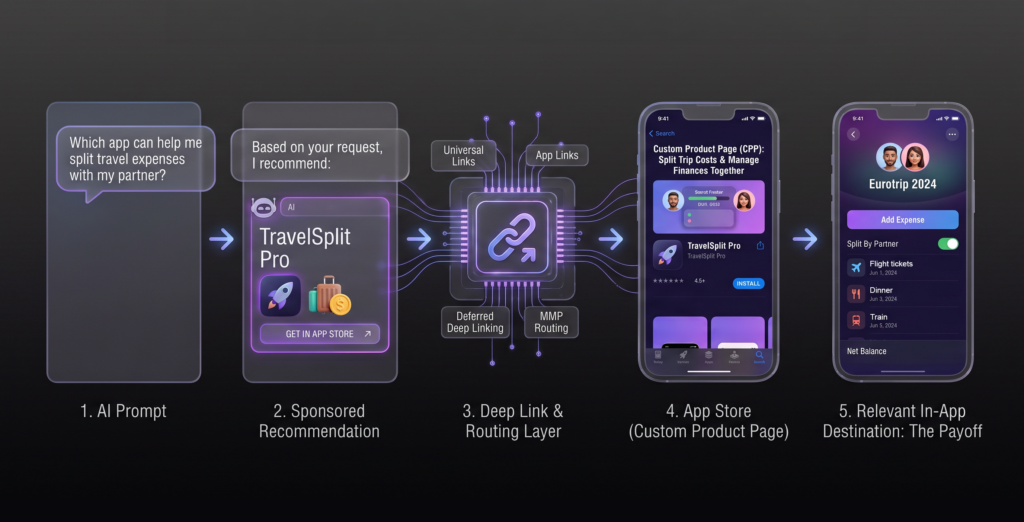
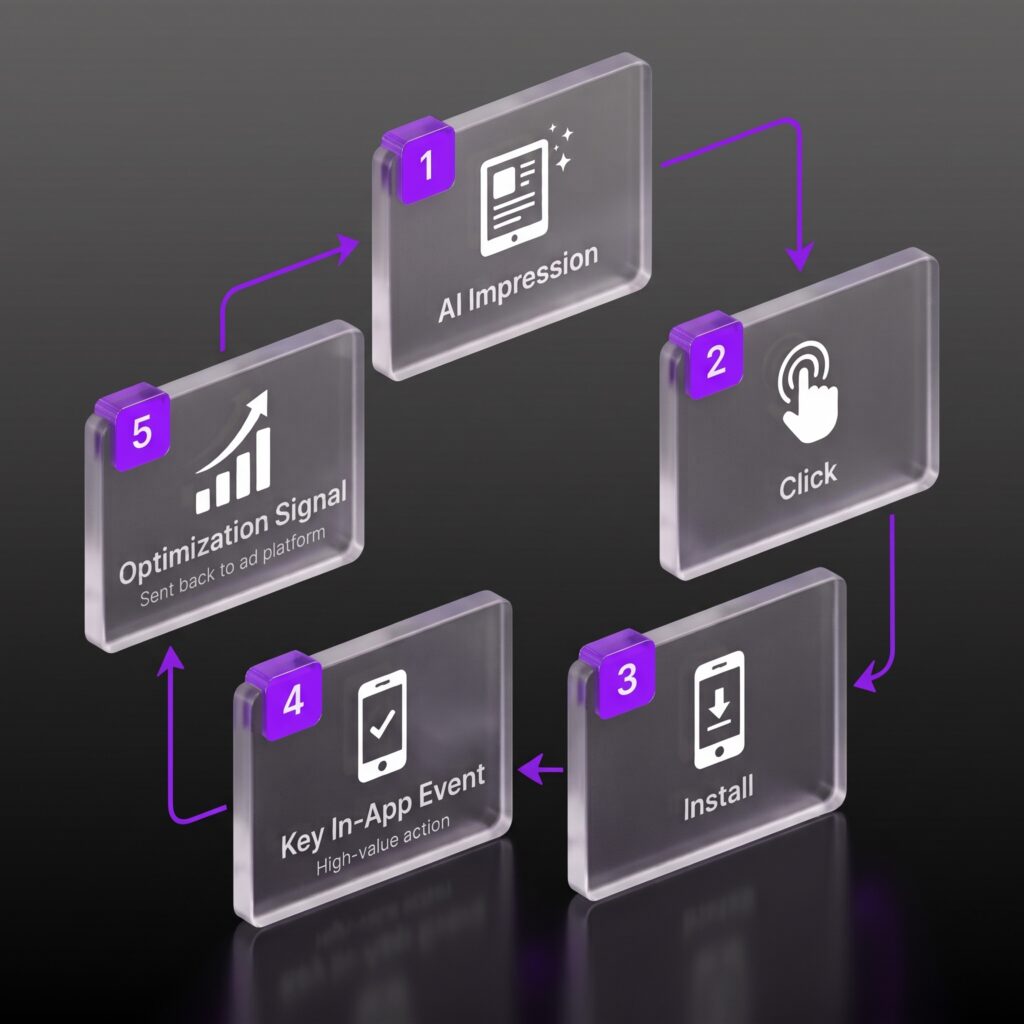
ChatGPT conversation → Sponsored Placement → MMP Tracking Link → App Store → Install → First Open → Relevant In-App Experience → Conversion
ChatGPT Ads currently supports direct integration with AppsFlyer, Adjust and Branch. For mobile apps, the attribution setup uses a tracking link generated by the MMP, while event data can be shared back for reporting and optimization. Attribution through these MMP integrations is currently click-based.
That means many app teams won’t need to reinvent their measurement infrastructure. But having an integration available and having a reliable setup are two very different things.
Before launch, test the journey yourself.
- Does the correct tracking link fire?
- Does the user reach the intended store page?
- Is the install attributed correctly?
- Does the intended in-app destination open?
- Does the conversion event arrive under the expected name and parameters?
Don’t trust the setup simply because every dashboard says “connected”. One broken redirect or incorrectly mapped event is enough to lose the context you just paid to acquire.
3. Don't Send Specific Intent to a Generic App Experience
This is where AI-driven acquisition becomes particularly interesting for apps.
Imagine someone asks:
“What’s an app that can help me split expenses with friends while travelling?”
They see a relevant ad for your app and click. Then they land on a generic App Store page showing five completely different product features. You’ve just lost the strongest part of the original touchpoint: context.
As discovery becomes more specific, the post-click journey matters even more. For iOS, Custom Product Pages allow teams to create different versions of an App Store page for specific features or use cases, each with its own URL. Apple also supports assigning an app deep link to a Custom Product Page, allowing supported users to open a specific destination inside the app. So the travel-expense example could lead to a store experience focused specifically on shared expenses rather than your generic product page. Deep linking becomes just as important after the install. For a broader introduction, see our deep linking guide.
Use Universal Links and App Links for installed users. On iOS, Universal Links can open the relevant content directly inside the app. If the app isn’t installed, the associated website opens instead, so your routing or MMP setup still needs to handle the uninstalled-user journey separately.
Use tailored store pages where the use case justifies it. If you’re testing clearly different intents, generic store messaging may hide the feature that actually made the user click.
Think beyond the install. Where your technical setup supports it, deferred deep linking can preserve campaign context so the user reaches the relevant experience after installing the app instead of starting from zero.
Test every fallback: installed app, no app, iOS, Android, web fallback and first open. Don’t only test the ideal journey.
If ChatGPT understands what the user wants but your store presence and onboarding journey don’t, you’re wasting one of the most crucial parts of the channel.
On iOS, this can mean directing users to a relevant Custom Product Page; on Android, the equivalent can be a tailored Custom Store Listing.
4. Decide What a Valuable Conversion Actually Is
Once attribution works, the next question is what you want the platform to learn from.
OpenAI supports conversion measurement through its Pixel and Conversions API, as well as mobile measurement through supported MMP integrations. Advertisers can map app events and use attributed conversions for reporting and optimization. But more events don’t automatically mean better measurement.
Imagine a subscription app tracks:
Install → Registration → Onboarding Completed → Trial Started → Subscription Purchased
Technically, several of these events could be used as conversion signals. The more useful question is: Which event actually represents success for this campaign?
An install produces a lot of volume but says very little about user quality. A paid annual subscription represents real value but might happen too rarely to provide enough signal during an early test.
Your primary conversion should therefore be far enough down the funnel to indicate meaningful value, while still occurring frequently enough to be useful for learning and optimization.
Before launching, make sure:
- Your core events are implemented consistently in your MMP.
- Event names and parameters mean the same thing across platforms.
- The correct ChatGPT Ads conversion is mapped to the campaign. (Source 4)
- You understand which events are shared with the advertising platform and why.
- Your privacy and consent setup covers the additional data destination where required. (Source 5)
This is also where platform and MMP numbers need to be interpreted carefully.
Ads Manager currently supports click-through reporting windows of 7, 14 or 30 days and either no view-through reporting or a one-day view-through window. MMP integrations have their own attribution configurations. Differences in attribution windows, timestamps, consent conditions or deduplication can therefore lead to different conversion totals without necessarily indicating a broken implementation.
5. Treat the First Campaign as an Experiment:
- One clearly defined use case,
- One meaningful primary conversion,
- A dedicated ad group and messaging,
- A relevant store and post-install experience,
- Clean MMP attribution,
- A controlled testing budget,And a documented measurement setup.
What About Google AI Search Ads?
ChatGPT isn’t the only platform moving advertising closer to AI-driven discovery.
Google can serve existing Search, Shopping, Performance Max, local and App ads above or below AI Overviews in all 200+ markets where AI Overviews are available. Ads placed directly inside AI Overviews remain limited to selected English-language markets and are not currently available in Germany.
For app teams, however, the underlying lesson is similar:
As discovery becomes more contextual, the connection between user intent, creative, landing experience and downstream measurement becomes more important – not less. That’s why the infrastructure you build for one new acquisition surface shouldn’t be channel-specific wherever it doesn’t need to be.
Action Plan: What App Growth Teams Should Do Today
- Identify 1 to 3 concrete app use cases worth testing in ChatGPT Ads.
- Build ad groups and context hints around real user needs instead of generic keyword lists.
- Map the complete journey from conversation to in-app conversion before launching.
- Connect your MMP and verify the campaign tracking link end-to-end.
- Audit your Universal Links, App Links, deferred deep links and fallback routing.
- Create relevant Custom Product Pages or alternative tailored store experiences where useful.
- Decide which in-app event actually represents a valuable conversion.
- Review event mapping, attribution windows and deduplication before comparing platform and MMP reporting.
- Review consent and data-sharing requirements before adding another advertising destination.
- Start with a controlled test and evaluate downstream app value, not just clicks or installs.
The Bottom Line: The Ad Format Is New. The Fundamentals Aren't.
Relevant intent → Relevant ad → Relevant store experience → Correct app destination → Meaningful conversion → Reliable attribution
The advertisers with the strongest foundation across those steps will be in a much better position to evaluate the channel than those simply adding another campaign to their media plan. ChatGPT Ads introduce a new acquisition surface. They don’t replace the fundamentals of mobile measurement; instead, they make them even more relevant.
Need Help Getting Your App Measurement Ready?
New acquisition channels get complicated quickly once MMP attribution, deep linking, store experiences, conversion events and privacy requirements come together.
At Customlytics, we support app growth teams across measurement setup, MMP configuration, deep linking and campaign strategy – helping teams build the infrastructure they need to test new acquisition channels without losing visibility after the click.
Contact Customlytics to discuss how we can help your team set up and measure ChatGPT Ads for your app.
- OpenAI: ChatGPT Ads expands across Europe
- OpenAI: Ads Manager Availability
- OpenAI: Create Ad Groups for ChatGPT Ads
- OpenAI: Set up Mobile Measurement Partner Integrations
- OpenAI: Conversion Measurement
- OpenAI: Measure Results
- OpenAI: Ads Manager Beta Overview
- OpenAI: Create Campaigns for ChatGPT Ads
- Apple Developer: Custom Product Pages
- Apple Developer: Allowing apps and websites to link to your content
- Google Ads Help: About ads and AI Overviews
- Customlytics: Deep linking guide to master mobile marketing
- Customlytics: 7 ideas for Apple’s custom product pages